
Keto Macros Calculator
This calculator estimates a daily calorie target from your age, sex, height, weight, activity level and planning goal, then splits that target into net-carb, protein and fat grams. It runs entirely in your browser — nothing you enter is sent anywhere, saved, or logged[1]. If you're new to the diet, start with what the keto diet is; if you already track macros, see how to calculate net carbs from a label for the products you eat.
Key takeaways
- Everything runs in your browser only — nothing you type is sent anywhere, saved, or logged.
- Results are planning estimates based on the Mifflin-St Jeor formula, not a diagnosis or a medically necessary target.
- Your net-carb target and protein share are inputs you choose, not outputs the calculator derives — both are editable.
- This tool is not intended for anyone under 18, during pregnancy or breastfeeding, or for adjusting diabetes medication or insulin.
Calculate your keto macros
Enter your details below. Age must be 18 or older — this tool is not intended for minors. All fields are used only for this one calculation; nothing is saved after you leave the page. You can switch between U.S. and metric units at any time, and the fields below the unit toggle will update to match. The net-carb target and protein share fields both start with a commonly used planning default, but both are editable — neither default is presented as medically ideal for every reader, and changing them changes the fat result accordingly.
See the formulas and assumptions
- Resting energy (Mifflin-St Jeor): Male =
10×kg + 6.25×cm − 5×age + 5; Female =10×kg + 6.25×cm − 5×age − 161. - Activity multipliers: Sedentary ×1.2, Lightly active ×1.375, Moderately active ×1.55, Very active ×1.725, Extra active ×1.9.
- Goal adjustment: Maintain ×1.0, Gradual loss ×0.90 (10% below maintenance), Gradual gain ×1.10 (10% above maintenance).
- Net carbs: your entered gram target × 4 calories/gram.
- Protein: planning calories × your entered protein share ÷ 4 calories/gram.
- Fat: all remaining planning calories ÷ 9 calories/gram, after carb and protein calories are subtracted.
- This tool never produces a plan below 1,000 calories/day — below that range it shows a message instead of a number, and recommends individualized professional guidance.
- Results are planning estimates, not exact requirements, and do not guarantee ketosis, weight loss or muscle gain.
What does this calculator estimate?
It produces seven related numbers from the details you enter: an estimated resting energy expenditure, an estimated maintenance-calorie level, a planning-calorie target adjusted for your selected goal, a daily net-carbohydrate gram target, a daily protein gram target, a daily fat gram target, and the approximate percentage of your planning calories each of those macros represents. Every number is a planning estimate based on the information you enter, not a diagnosis, a medically necessary target, or a guarantee of any particular outcome. This tool is separate from — and does not replace — The Keto Scan's product-level net-carb calculator, which works from an individual product's Nutrition Facts label rather than from your personal information.
How does this calculator estimate my numbers?
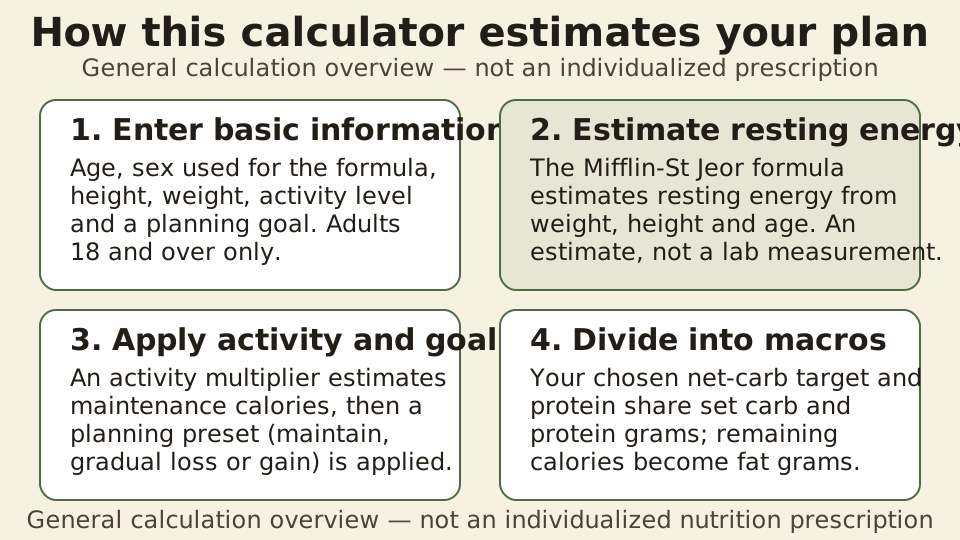
It uses the Mifflin-St Jeor equation, a resting-energy formula derived from indirect-calorimetry measurements of 498 healthy adults and published in the American Journal of Clinical Nutrition, to estimate your resting energy expenditure (REE) from weight, height, age and sex[2]. That estimate is multiplied by an activity factor to approximate maintenance calories, then adjusted by your selected planning goal (maintain, gradual loss, or gradual gain). Finally, your chosen net-carb target and protein share are converted to grams using the standard 4/4/9 calories-per-gram conversion factors used on U.S. Nutrition Facts labels[5], and the remaining calories become your fat target.
Why can actual energy needs differ?
The Mifflin-St Jeor equation was derived from a group of 498 healthy adults measured by indirect calorimetry[2]. It performs well on average across that kind of population, but no formula can account for an individual's exact metabolism. Several factors can shift a person's real resting energy expenditure above or below what a formula predicts from weight, height, age and sex alone, including:
- body composition and muscle mass
- genetics
- sleep and stress
- certain medical conditions
- certain medications
The activity multiplier adds a second layer of estimation, since it approximates a general activity category rather than measuring your actual movement. The goal adjustment is a planning assumption too — it is not a guarantee that a specific rate of weight change will occur. Treat the result as a starting point, and test it against how your own weight and energy trend over several weeks rather than following it rigidly. Two people who enter identical numbers can still see different real-world results simply because they classify their own activity level differently: the five categories describe broad movement patterns rather than a measured calorie burn, so choosing between two adjacent categories is often a judgment call, not a precise selection. Once you have a macro target from this calculator, remember it estimates your personal daily allowance only — you will still need to work out the net carbs in each specific packaged food you eat, since this tool has no visibility into what is actually in your pantry or on your plate.
Who should not rely on a general macro calculator?
This calculator is intended for general adult educational planning only. It is not intended for people under 18, and it is not intended for use during pregnancy or breastfeeding[3]. It is also not appropriate for diagnosing a metabolic condition, adjusting diabetes medication, calculating insulin, managing diabetic ketoacidosis, or determining whether a ketogenic diet is medically safe for a specific person.
Talk with a healthcare professional before using a planning estimate like this one if any of the following apply to you:
- diabetes, kidney disease, liver disease, or pancreatic disease
- a prescription medication affected by carbohydrate intake
- a history of an eating disorder
- a medically supervised diet
Our keto diet side effects and safety considerations guide covers several of these situations in more depth. This calculator does not provide medication adjustment advice, insulin guidance, glucose targets, ketone thresholds, electrolyte doses, or emergency treatment instructions.
What if my numbers look different from another calculator?
Resting-energy formulas are estimates, not measurements, and different calculators use different formulas, activity multipliers, or goal adjustments[2]. A different tool that uses the Harris-Benedict equation, a different activity scale, or a different percentage for a "cut" or "bulk" will produce a different number from the same inputs — neither is simply "wrong." People who lose weight at a gradual, steady pace tend to keep it off more successfully than people who change their intake very quickly[4], which is part of why this calculator's loss and gain presets are modest 10% adjustments rather than aggressive ones. Use this calculator as a starting point, then adjust based on how your weight and energy actually trend over a few weeks. Once you have a daily net-carb target, our net-carb calculation guide shows how to apply it to individual food labels, and our net carbs vs. total carbs guide explains why that figure differs from the Total Carbohydrate line alone.
Keto macro calculation overview
The table below summarizes each result this calculator produces, how it's estimated, what can affect it, and an important limitation to keep in mind.
| Result | How it is estimated | What can affect it | Important limitation |
|---|---|---|---|
| Resting energy estimate | Mifflin-St Jeor formula from weight, height, age and sex | Body composition, genetics, medical conditions | An estimate, not a measured value |
| Maintenance calories | Resting energy × selected activity multiplier | How accurately the activity level matches real life | Only as accurate as the selected activity level |
| Planning calories | Maintenance calories × selected goal adjustment | Selected planning goal (maintain, loss, gain) | A planning assumption, not a guaranteed rate of change |
| Net carbohydrates | Your entered gram target × 4 calories/gram | The target you choose to enter | Does not deduct fiber or sugar alcohols itself |
| Protein | Planning calories × your entered protein share ÷ 4 | The percentage you choose to enter | A planning input, not a prescribed requirement |
| Fat | Remaining planning calories ÷ 9, after carbs and protein | Your net-carb and protein selections | Can be blocked if carb/protein settings leave no calories for fat |
Where do I get started once I have my macros?
With calorie and macro targets in hand, the next steps are usually building a shopping list from our keto grocery guide, checking the complete list of keto-friendly foods, and watching for foods with hidden carbs that can quietly push you over your target. If you're adjusting an existing diet, our keto food swaps guide covers practical lower-carb alternatives to common foods, and our guide to reading nutrition labels shows where these grams come from on a real package.
A reasonable way to use the result is as a first estimate rather than a fixed rule: track how you feel and how your weight trends over two to four weeks, then revisit the calculator if your circumstances change — a different activity level, a new planning goal, or simply an updated weight. Because the net-carb target and protein share here are inputs you choose rather than outputs the formula derives, you can also use the calculator to see how adjusting either one changes your resulting fat target, before deciding which combination fits your food preferences and how you plan to eat day to day.
Review Packaged Foods with The Keto Scan
This calculator estimates daily macro planning values from the information you enter. Separately, The Keto Scan reviews available product-label and barcode data — such as ingredients and Total Carbohydrate — so you can check how a packaged food fits the net-carb target above. The scanner does not determine your personal energy needs, does not guarantee ketosis, and does not replace the macro estimate above; its results depend on the available product or label data, so always confirm the package yourself.
Scan a product now →Sources and references
- The Keto Scan — this calculator's source code, privacy behavior and calculation logic are described in the "See the formulas and assumptions" section above.
- Mifflin MD, St Jeor ST, Hill LA, et al., American Journal of Clinical Nutrition — A new predictive equation for resting energy expenditure in healthy individuals (PMID 2305711)
- National Institute of Diabetes and Digestive and Kidney Diseases (NIDDK) — Body Weight Planner
- Centers for Disease Control and Prevention (CDC) — Steps for Losing Weight
- U.S. Food and Drug Administration (eCFR) — 21 CFR § 101.9 — Nutrition labeling of food
This calculator is educational, not personal medical advice, and does not diagnose or treat any condition. Sources are selected from government, institutional, and peer-reviewed research where available. For guidance on your own health or diet, consult a qualified healthcare professional. See our editorial standards and full Disclaimer.