
Net Carbs vs Total Carbs: What's the Difference?
If you're new to the keto diet, the difference between net carbs and total carbs is one of the most important things you'll learn. Getting this wrong is one of the most common reasons people stall on keto — or give up thinking it isn't working.
What Are Total Carbs?
Total carbohydrates is the number you see on every nutrition label. It includes all forms of carbohydrate in a food — digestible starches, sugars, dietary fiber, and sugar alcohols. The FDA requires this number on every packaged food sold in the United States[1].
What Are Net Carbs?
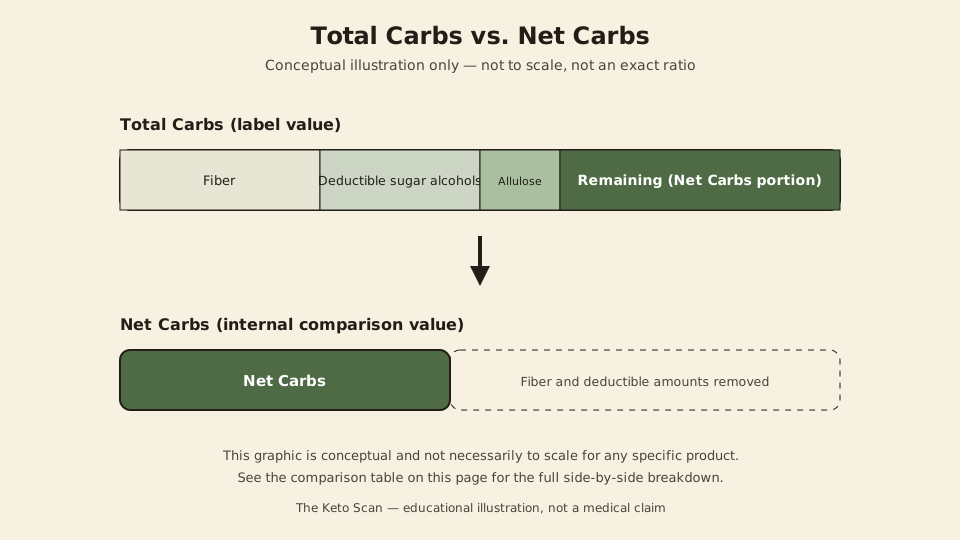
Net carbs is not an FDA-regulated term — it's a concept used in low-carb nutrition to represent the carbohydrates your body actually absorbs and converts to glucose[2]. It's calculated by subtracting the carbs your body can't digest:
Net Carbs = Total Carbs − Dietary Fiber − Deductible Sugar Alcohols − Deductible Allulose
This is the simplified version — in practice, The Keto Scan doesn't deduct every reported sugar-alcohol (or allulose) gram at the same rate. See the full worked example and the complete per-type breakdown in our guide to how to calculate net carbs.
Total Carbs vs. Net Carbs at a Glance
| Topic | Total Carbs | Net Carbs |
|---|---|---|
| What it represents | Every carbohydrate in the food, digestible or not | The portion your body actually absorbs and converts to glucose |
| Where it appears | The bold "Total Carbohydrate" line on the Nutrition Facts label — see our guide to reading nutrition labels for the full label-reading order | Not on the label — it's calculated from the label's numbers |
| What it includes | Starches, sugars, dietary fiber, and sugar alcohols combined | Total carbs minus fiber minus the deductible portion of sugar alcohols and allulose |
| What The Keto Scan subtracts | Nothing — this is the raw label figure | Dietary fiber in full, plus sugar alcohols/allulose at The Keto Scan's own internal percentages (see the full table) |
| How The Keto Scan uses it | Reads it from the scanned product's nutrition data | Displays it as the main number for keto suitability, alongside the Keto Score |
| Important limitation | Can overstate how "off-keto" a high-fiber food looks | An internal product-comparison estimate, not a medical or blood-glucose prediction |
Why doesn't fiber count toward net carbs?
Dietary fiber is a carbohydrate, but your body doesn't have the enzymes to break it down and absorb it as glucose. Instead, it passes through your digestive system largely intact. It doesn't raise blood sugar in the way digestible carbohydrate does, and it isn't counted toward net carbs for that reason. This is one reason high-fiber vegetables can have a much lower net-carb value than their total-carb figure would suggest.
Why can net-carb values differ between products or calculators?
Sugar alcohols aren't all treated the same way, and the label doesn't tell you how much of each type to deduct. The Keto Scan deducts erythritol in full under its internal product-comparison methodology. Allulose, a rare sugar that is not chemically a sugar alcohol, is also deducted in full under its own internal rule. Xylitol, maltitol, and the other sugar alcohols are each deducted at their own, smaller percentage. Because "net carbs" is not an FDA-defined term, another brand, app, or package claim may use different deduction assumptions and legitimately arrive at a different number from the same label. See the full per-type deduction table and worked examples in our guide to how to calculate net carbs.
When should you compare total carbs instead of net carbs?
Total carbs is the safer number to compare when you want the exact, government-mandated figure without relying on any calculator's assumptions — for example, when checking a product against a doctor-prescribed carbohydrate limit, or when a label doesn't clearly identify which sugar alcohol it contains (making an accurate net-carb deduction impossible). Total carbs is also the more consistent number for comparing very different food categories, since it doesn't depend on any single methodology's deduction choices. When comparing an everyday food against a possible substitute on the same serving basis, our keto food swaps guide covers practical lower-carbohydrate alternatives.
When is an internal net-carb calculation useful?
A net-carb calculation is most useful when comparing packaged, low-carb-marketed products against each other for keto suitability — for example, deciding between two protein bars that both list sugar alcohols. Track net carbs for this kind of product comparison rather than total carbs, since total carbs alone tends to unfairly penalize high-fiber whole foods like vegetables. Total sugars on a label also include naturally occurring sugars alongside any added sugars, so the added-sugars line is a more specific number to watch than total sugars alone[3]. Whichever number you track, remember it is a comparison convention, not a prediction of your individual blood-glucose response — watch out for hidden carbs that can push a day's total higher than expected.
A simple conceptual example
A cup of broccoli lists 6g of total carbs and 4g of dietary fiber, with no sugar alcohols. Net carbs = 6 − 4 = 2g. The full carb count looks larger on the label, but most of it is fiber the body doesn't absorb as glucose — which is why broccoli, despite having "carbs" on the label, is typically counted as very keto-friendly. The same total-vs-net gap shows up in other high-fiber foods: Avocado (1 medium) lists roughly 17g total carbs but only about 3g net carbs once fiber is subtracted, while a lower-fiber food like Banana (1 medium) keeps most of its total carbs as net carbs. For calculations involving sugar alcohols or allulose, see the complete worked examples on how to calculate net carbs.
Let The Keto Scan Do the Math
Every time you scan a product with The Keto Scan, it automatically calculates net carbs for you — total carbs minus fiber minus the deductible portion of any sugar alcohols, based on which type is listed in the ingredients — and shows you the exact math in "Show the calculation." No guessing, no label confusion.
Try The Keto Scan →Sources and references
- U.S. Food and Drug Administration — What's on the Nutrition Facts Label
- U.S. Food and Drug Administration — How to Understand and Use the Nutrition Facts Label
- U.S. Food and Drug Administration — Added Sugars on the Nutrition Facts Label
This article is educational, not personal medical advice. Sources are selected from government, institutional, and peer-reviewed research where available. For guidance on your own health or diet, consult a qualified healthcare professional. See our editorial standards and full Disclaimer.