
How to Calculate Net Carbs
Net carbs are the carbohydrates that your body actually digests and converts to glucose. Fiber and most sugar alcohols pass through without raising blood sugar, so they don't count toward your keto carb limit. Knowing how to calculate net carbs is the most important skill for anyone following the keto diet. Note that "net carbs" is a low-carb community convention, not a term defined or required on the FDA Nutrition Facts label itself[1].
How do you calculate net carbs?
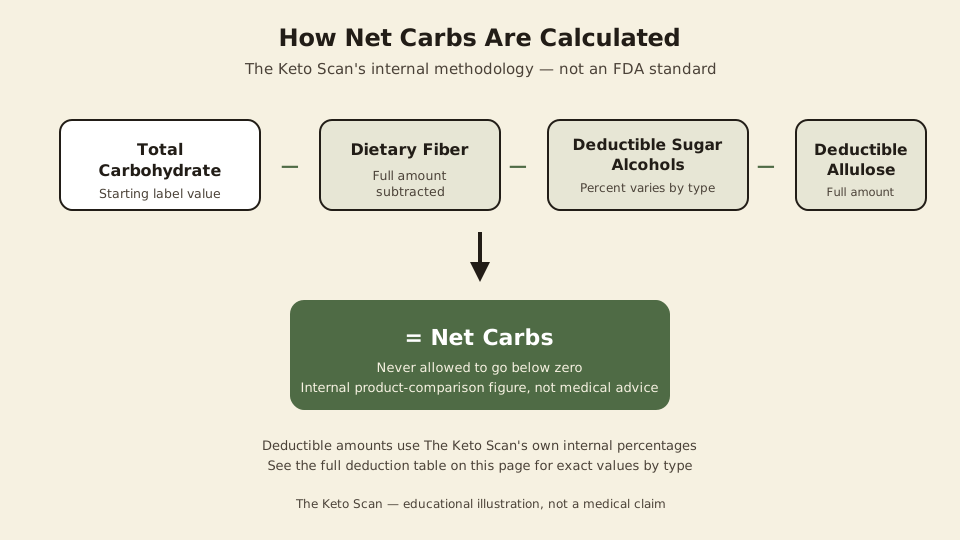
Net Carbs = Total Carbs − Dietary Fiber − Deductible Sugar Alcohols − Deductible Allulose
"Deductible" means the amount calculated using The Keto Scan's internal percentages below — not every reported gram of sugar alcohol (or allulose) is subtracted. The app always prefers the quantity printed on the label; if a product's data is missing that figure, a narrower fallback estimate is used only as a last resort. The final result is never allowed to go below zero. Curious why total carbs alone isn't the number to track? See our full breakdown of net carbs vs. total carbs.
Where do you find the numbers on a food label?
Pick up a product and look at the Nutrition Facts label. You need three numbers[2] (see our guide to reading nutrition labels for the full reading order, including where these values come from on the label):
1. Total Carbohydrate — find this bold line on the label
2. Dietary Fiber — listed underneath Total Carbohydrate
3. Sugar Alcohols — listed if the product contains erythritol, xylitol, or similar
If you're deciding between an original higher-carbohydrate food and a possible replacement, our keto food swaps guide covers practical lower-carbohydrate alternatives worth comparing before you calculate.
What does a worked calculation look like?
Example 1 — erythritol. A product shows Total Carbs 28g, Dietary Fiber 8g, Sugar Alcohols 6g, and the ingredients list identifies the sugar alcohol as erythritol.
Net Carbs = 28 − 8 − (6 × 100%) = 28 − 8 − 6 = 14g net carbs (The Keto Scan deducts erythritol in full under its internal methodology).
Example 2 — maltitol. A protein bar lists Total Carbs 22g, Dietary Fiber 3g, and Sugar Alcohols 9g, with maltitol identified in the ingredients. Maltitol is deducted at 35% under The Keto Scan's methodology, so 65% of the reported grams still counts toward net carbs.
Deductible maltitol = 9 × 0.35 = 3.15g.
Net Carbs = 22 − 3 − 3.15 = 15.85g net carbs — notably higher than it would be if maltitol were deducted the same way as erythritol.
Example 3 — allulose plus fiber, no sugar alcohol. A baked good lists Total Carbs 18g, Dietary Fiber 2g, and Allulose 5g, with no sugar alcohol on the label.
Net Carbs = 18 − 2 − 5 = 11g net carbs (allulose is deducted in full, the same as erythritol, because The Keto Scan treats it as 100% deductible under its internal methodology even though it is chemically a rare sugar, not a sugar alcohol). If a calculation would otherwise go negative — for example a very high-fiber, low-carb product — the result is always shown as 0g, never a negative number.
Why doesn't fiber count toward net carbs?
Dietary fiber is a carbohydrate but humans can't digest it. It passes through the digestive system without being absorbed, so it doesn't raise blood glucose or interfere with ketosis. This is why high-fiber foods like avocados, broccoli, and flaxseed are keto staples despite having carbohydrates on the label.
Which sugar alcohols does The Keto Scan deduct, and how much?
Sugar alcohols (also called polyols) are not all the same, and the Nutrition Facts label doesn't report how much of each type to deduct[2]. The grams-of-sugar-alcohol figure on the label comes from the Nutrition Facts panel itself — The Keto Scan uses that reported number rather than guessing a quantity from the ingredients list. What the ingredients list does tell you is which sugar alcohol is present, and The Keto Scan uses that to decide how much of the reported grams counts toward net carbs.
A note on allulose: allulose is a rare sugar — it is not chemically a sugar alcohol or polyol. The Keto Scan tracks it as a separate category in its methodology and deducts it in full under its own internal rule. For barcode-scanned products, there is no separate per-provider allulose field in the underlying nutrition data, so allulose is carried through the same reported-quantity data channel as sugar alcohols; that is a data-handling detail of how the app receives label data, and does not change allulose's classification as a rare sugar rather than a sugar alcohol. The site's manual product-entry form has its own dedicated Allulose field, so the two are never double-counted there.
The values below are The Keto Scan's internal product-comparison deductions. They are not FDA standards, not medical guidance, and not a prediction of an individual's blood-glucose response.
| Substance or label description | The Keto Scan internal deduction | Application note |
|---|---|---|
| Erythritol | 100% | Full reported amount deducted |
| Allulose | 100% | Full reported amount deducted; not chemically a sugar alcohol |
| Xylitol | 60% | Remaining 40% counted toward net carbs |
| Sorbitol | 50% | Remaining 50% counted toward net carbs |
| Isomalt | 50% | Remaining 50% counted toward net carbs |
| Mannitol | 50% | Remaining 50% counted toward net carbs |
| Lactitol | 50% | Remaining 50% counted toward net carbs |
| Maltitol | 35% | Remaining 65% counted toward net carbs |
| Maltitol syrup | 25% | Remaining 75% counted toward net carbs |
| Unknown or mixed sugar alcohols | 50% | Internal fallback used when the label reports a sugar-alcohol amount but the ingredients don't identify which one, or list more than one |
These are The Keto Scan's internal product-comparison deductions — not FDA standards, not medical guidance, and not a prediction of an individual's blood-glucose response. If you're managing a medical condition, talk to a healthcare professional about how specific sweeteners affect you.
What common mistakes lead to an incorrect net-carb calculation?
Even with the right formula, a few practical mistakes commonly produce a wrong result:
Mixing numbers from different serving sizes. If Total Carbohydrate is read from one serving size and Dietary Fiber or Sugar Alcohols from a different one (for example, a package with two serving-size claims, or comparing a "per serving" figure to a "per 100g" figure), the subtraction no longer describes the same portion of food.
Subtracting total sugar instead of dietary fiber. Total sugar is not deductible — only dietary fiber and the deductible portion of sugar alcohols/allulose are subtracted. Sugar (including natural sugar) still counts fully toward net carbs.
Subtracting all sugar alcohols at 100%. Only erythritol and allulose are deducted in full under The Keto Scan's methodology. Xylitol, sorbitol, isomalt, mannitol, lactitol, and the maltitol variants are only partly deductible, so assuming a full deduction for any of them overstates how "net" the carbs really are.
Overlooking allulose. Because allulose isn't a sugar alcohol, it's easy to skip when scanning for "sugar alcohol" wording on a label. Under this methodology it is deducted in full, so missing it understates how keto-friendly a product actually is.
Forgetting the floor at zero. A calculation that subtracts more than the Total Carbohydrate figure should never produce a negative result — the correct net-carb value is 0g, not a negative number.
Comparing products with different serving bases. A product listed per 30g serving cannot be fairly compared to one listed per 100g without first converting to the same basis — otherwise a "lower net carbs" product may simply have a smaller serving size.
Try It Yourself: Net Carb Calculator
Enter the numbers from a Nutrition Facts label to see the exact math for one serving. This tool uses the same internal deduction percentages as the table above and as The Keto Scan's barcode scanner.
Keto Net Carb Limits
🟢 0–3g per serving — Very Keto-Friendly
🟢 4–6g per serving — Keto-Friendly
🟡 7–10g per serving — Moderate — Portion Matters
🟠 11–15g per serving — High for Keto
🔴 Above 15g per serving — Usually Not Keto-Friendly
Remember: this is per serving of a product, not your total daily limit — pay attention to how many servings are actually in the package[3]. Most people on keto aim for 20–50g of net carbs total across the whole day; The Keto Scan uses the ranges above as its own general product-classification method, not an official government or medical standard. Some products hide more carbs than the label suggests at a glance — see our guide to hidden carbs in keto foods.
Why might another app show a different net-carb result?
"Net carbs" is not a single standardized calculation — it's a low-carb community convention, so different apps and brands can legitimately reach different numbers from the same label[1]. Common reasons for a mismatch: another source deducts a sugar alcohol at a different percentage than the table above, deducts allulose differently or not at all, rounds differently, or uses a manufacturer's own "net carbs" claim on the package instead of calculating it independently. None of these differences means either number is "wrong" in an absolute sense — they reflect different internal methodologies, and The Keto Scan's figures are its own product-comparison convention, not an FDA-defined value.
The Shortcut
Instead of doing the math every time you pick up a product, let The Keto Scan do it for you instantly. Scan any barcode and get the net carbs, a keto score, and a clear verdict — no label math required.
Skip the math. Scan any barcode and The Keto Scan calculates net carbs for you instantly using data from Edamam, USDA, and Open Food Facts.
Try The Keto Scan →Sources and references
- U.S. Food and Drug Administration — What's on the Nutrition Facts Label
- U.S. Food and Drug Administration — How to Understand and Use the Nutrition Facts Label
- U.S. Food and Drug Administration — Serving Size on the Nutrition Facts Label
This article is educational, not personal medical advice. Sources are selected from government, institutional, and peer-reviewed research where available. For guidance on your own health or diet, consult a qualified healthcare professional. See our editorial standards and full Disclaimer.