
Hidden Carbs in Foods: Where to Find Them
What are hidden carbs?
"Hidden carbs" describes carbohydrate that is fully disclosed on the package but easy to miss — not carbohydrate that a manufacturer is legally required to hide or that violates labeling law. A product can be entirely compliant with FDA labeling rules and still surprise a reader who doesn't check serving size, doesn't read the ingredient list, or trusts a front-of-package claim like "sugar-free" or "keto" instead of the Nutrition Facts panel. Understanding where these overlooked carbohydrates typically show up makes label reading faster and more reliable, whether or not you're following a keto-style eating pattern.
Why are some carbohydrates easy to overlook?
The Nutrition Facts panel and the ingredient list serve different purposes and neither one alone tells the full story. The panel gives quantities — grams of Total Carbohydrate, fiber, sugars — for one serving, while the ingredient list tells you what's in the product and roughly how much of each ingredient, by weight order, but not exact grams. A product can look reasonable on the panel while its ingredient list shows sugar, syrup, or starch high on the list, or vice versa. Reading only one of the two sections is the most common reason a genuinely higher-carb product gets missed.
How can serving size make a product look lower in carbs?
Every number on a Nutrition Facts panel is reported per serving, and manufacturers set the serving size — sometimes smaller than the amount most people actually eat in one sitting[3]. A bag of crackers listing 10g net carbs "per serving" can contain 2.5 servings per bag; eating what looks like a normal portion may mean eating two or three labeled servings. Always check "servings per container" next to the serving size, and if you're eating more than one labeled serving, multiply the carb figures accordingly before deciding whether a product fits your plan.
Where do overlooked carbohydrates commonly appear?
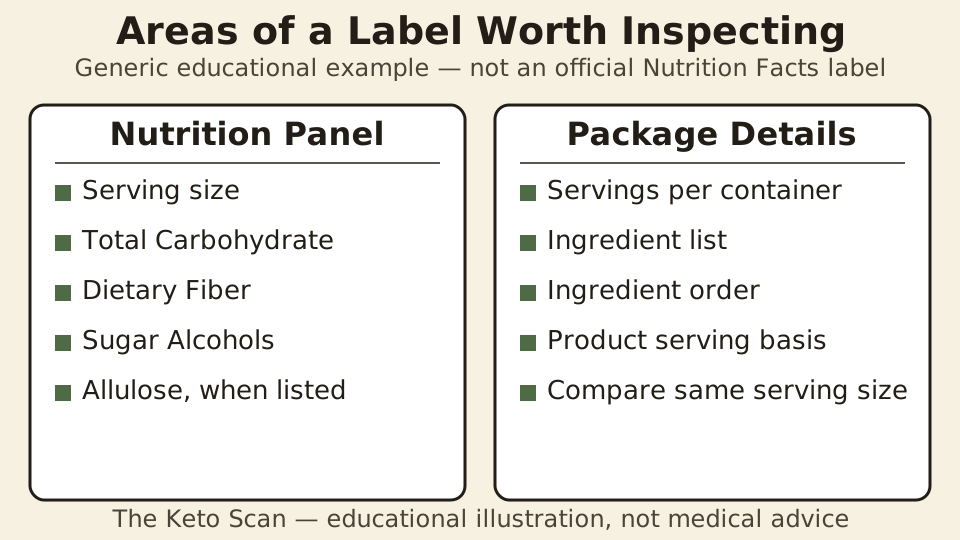
The label areas below are the same ones referenced throughout this guide — checking them before you buy is the fastest way to catch a product that carries more carbohydrate than it first appears to.
| Label clue | Where it appears | What to inspect |
|---|---|---|
| Serving size | Top of the Nutrition Facts panel | Compare the same serving size across brands before assuming one product is lower-carb than another |
| Total Carbohydrate | Nutrition Facts panel | The starting figure before fiber and any deductible sweeteners are considered — see net carbs vs. total carbs |
| Dietary Fiber | Nutrition Facts panel | Subtracted from Total Carbohydrate when calculating net carbs |
| Sugar Alcohols | Nutrition Facts panel, when reported | The reported grams and which specific sugar alcohol is named in the ingredients — see the full deduction table in our net carb guide |
| Allulose | Ingredient list, and Nutrition Facts panel where separately reported | Allulose is a rare sugar, not a sugar alcohol, and is deducted in full under The Keto Scan's methodology |
| Ingredient list order | Below the Nutrition Facts panel | Ingredients are listed in descending order by weight, so sugar or syrups near the top signal a larger share of the product |
Which parts of the label should you inspect first?
For the complete step-by-step reading order, see our guide to reading nutrition labels for keto.
Start with serving size and servings per container, then Total Carbohydrate, then Dietary Fiber and any Sugar Alcohols reported on their own line — those figures are the direct inputs to net carbs. A few categories are worth the extra thirty seconds: dressings and sauces (some reduced-fat or fat-free dressings may contain added sugars or starches — compare the Nutrition Facts panel and ingredient list rather than assuming that lower fat means lower carbohydrate), flavored nuts and nut butters (plain almonds and a peanut butter with only peanuts and salt are low-carb; honey-roasted and most commercial sweetened versions are not), flavored dairy and coffee creamers (plain Greek yogurt is moderate in net carbs while flavored versions add sugar), and "sugar-free" or "keto"-labeled packaged snacks, where the front-of-package wording is not a regulated claim and the actual figure still depends on the panel and ingredient list — the panel's separate Added Sugars line is a more direct check than a front-of-package claim[2]. For sauces and coatings in particular, our keto food swaps guide covers common lower-carbohydrate alternatives worth considering instead. The same sweetened-sauce and hidden-carb patterns show up at restaurants too, just without a label to check — see our guide to eating out on keto for how to ask about them when ordering.
Which ingredient clues deserve closer attention?
Ingredients are listed in descending order by weight, so an ingredient near the top of the list makes up a larger share of the product than one near the bottom[1] — this is a general ordering signal, not a way to calculate an exact gram amount, since the label doesn't disclose precise proportions. Seeing sugar, corn syrup, maltodextrin, dextrose, or rice starch anywhere near the top of an ingredient list is a reasonable prompt to check the Total Carbohydrate figure more carefully, even if the front of the package makes a "low carb" or "keto" claim.
Hypothetical label example 1: a "sugar-free" barbecue sauce lists a serving size of 2 tablespoons with 3g Total Carbohydrate and 0g fiber, but the container holds 8 servings and a typical portion is closer to 4 tablespoons — doubling the practical carbs to 6g for that meal. Hypothetical label example 2: a "protein bar" lists maltitol syrup as its second ingredient, after only oats; under The Keto Scan's methodology, maltitol syrup is deducted at just 25% of its reported grams, so more of it remains in the calculated net carbs than a fully-deducted sweetener like erythritol would leave behind. Both examples are illustrative, not based on any specific real product.
What should you do when sugar alcohols or allulose appear?
When a Nutrition Facts panel reports Sugar Alcohols as a line item, check the ingredient list to see which specific sugar alcohol is used — the deduction applied to net carbs differs by type (for example, erythritol is deducted in full, while maltitol is deducted at only 35% of its reported grams under The Keto Scan's internal product-comparison methodology — far more conservatively than erythritol). Allulose is a rare sugar rather than a sugar alcohol and is deducted in full under this site's methodology when reported. The complete deduction table and formula live on our net carb calculation guide rather than being repeated here — that page is the canonical reference for exact percentages.
How do you compare two products fairly?
Compare products using the same serving size or the same weight basis (per 100g is useful when package sizes differ) before drawing any conclusion about which is lower in carbohydrate. Two snack bars with different serving sizes can look similar on net carbs per serving while actually differing once scaled to the same weight. This is the same principle covered in our grocery shopping guide for comparing products while shopping, and in net carbs vs. total carbs for why the net figure, not the total figure, is usually the more useful comparison point.
Where can you calculate the final net-carb estimate?
Once you've read the serving size, Total Carbohydrate, fiber, and any sugar alcohols or allulose from a label, our how to calculate net carbs guide walks through the full formula and worked examples step by step. For supported products, The Keto Scan can use available barcode or label information to estimate net carbs and provide a product score. Results depend on the data available, so confirm the package label and review low-confidence results carefully.
Review the Label Details with The Keto Scan
For supported products, scan a barcode to review available net-carb information, keto score, and The Keto Scan's product verdict. Results depend on the available product or label data, so always confirm the package.
Scan a product now →Sources and references
- U.S. Food and Drug Administration (eCFR) — 21 CFR 101.4 — Food; designation of ingredients
- U.S. Food and Drug Administration — Added Sugars on the Nutrition Facts Label
- U.S. Food and Drug Administration — Serving Size on the Nutrition Facts Label
This article is educational, not personal medical advice. Sources are selected from government, institutional, and peer-reviewed research where available. For guidance on your own health or diet, consult a qualified healthcare professional. See our editorial standards and full Disclaimer.